The transition from laboratory crystalliser to pilot-scale Nutsche filter is rarely seamless. Subtle changes in cooling profile or solvent composition can alter crystal morphology, and those changes immediately influence filtration behaviour. Flow slows, fines migrate, and cake structure tightens, leading to elevated differential pressure, extended cycle times, and uncertainty in the reliability of scale-up data.
If filtration media cannot adapt to changes in particle size distribution, crystal morphology, and solids loading during development, performance data can become distorted, conflating equipment limitation with intrinsic process behaviour and obscuring the true drivers of pressure drop, throughput, and wash efficiency. By incorporating interchangeable mesh pore sizes, pilot-scale Nutsche filter dryers eliminate fixed-media constraints, enabling systematic comparison of pore size against cake formation and resistance and ensuring that scale-up calculations reflect material behaviour, not filtration limitations.

Engineering Retention Control in Pilot-Scale Nutsche Filter Dryers
Filtration behaviour within pilot-scale Nutsche filter dryers is defined first and foremost through the interaction between mesh architecture and the developing cake structure. Pore size determines how effectively suspended solids are retained as the first layer of crystals deposits on the mesh surface and initiates cake formation.
The impact of pore size selection is typically observed through two contrasting effects:
- Oversized mesh pore openings – permit fine particles to migrate into the filtrate, affecting product recovery and filtrate quality.
- Undersized mesh pore openings – elevate differential pressure and suppress filtration rate.
Particle size distribution and crystal morphology do not remain constant during development, and even minor variations can disrupt the equilibrium between solid retention and hydraulic resistance. Mesh weave further influences this behaviour, with plain constructions favouring permeability and Dutch weaves delivering tighter retention accompanied by increased pressure drop.
Interchangeable mesh pore sizes in pilot-scale Nutsche filter dryers enable engineers to evaluate medium resistance alongside cake resistance under controlled conditions, generating filtration data that supports accurate scale-up modelling and informed equipment selection.
Enhancing Performance via Interchangeable Mesh Pore Sizes
Dynamic Response to Particle Size Distribution
Crystallisation process development routinely introduces variability that directly affects filtration behaviour. Adjustments to key process parameters can significantly alter particle characteristics including:
- Cooling rate
- Solvent composition
- Supersaturation control
- Seeding strategy
Such changes can shift particle size distribution, increase fines generation, or modify crystal morphology, all of which can influence how solids accumulate and compact on the filtration surface.
Fixed-media configurations often struggle under these process-driven variations, where reduced filtrate clarity or rising differential pressure may reflect mesh limitation rather than intrinsic cake properties. Interchangeable mesh pore sizes deliver a controlled response with pilot-scale Nutsche filter dryers, allowing retention and permeability to be aligned with evolving particle characteristics.
A finer mesh specification supports solid capture when fines increase, whereas a more open configuration enables improved drainage in cases where larger crystals yield lower hydraulic resistance. This adaptability ensures that pilot-scale Nutsche filter dryers can offer filtration data that accurately represents process performance, preserving yield and strengthening scale-up predictability.
Mitigating Filter Medium Blinding and Resistance
Resistance does not always originate in the cake itself. Fine particles can accumulate within mesh apertures or sintered pores, gradually restricting the open flow area and increasing hydraulic resistance, a phenomenon commonly described as blinding.
When pore openings become restricted, several responses emerge:
- Differential pressure rises
- Filtration rate declines
- Additional mechanical load is transferred to the agitator
In pilot-scale Nutsche filter dryers, where multiple crystallisation pathways are compared under controlled conditions, this resistance build-up can obscure true cake behaviour and extend development cycles. Interchangeable mesh pore sizes provide a controlled approach to isolating and mitigating resistance accumulation associated with mesh blinding.
Incremental adjustments to pore specification ensure engineers can identify the most open configuration that maintains required solid retention and limits pore obstruction. Even small increases in aperture can stabilise flow, accelerate mother liquor removal, and improve cycle consistency. With such controlled flexibility, pilot-scale Nutsche filter dryers can sustain predictable hydraulic performance across evolving development programmes, from early crystallisation screening and solvent system optimisation to impurity wash studies and pre-commercial scale-up validation.
Empirical Data Acquisition for Scale-Up
Accurate commercial filter design requires knowledge of how total hydraulic resistance, arising due to both the filter medium and the developing cake, evolves under controlled pilot conditions. Interchangeable mesh pore sizes introduce deliberate variability into pilot-scale Nutsche filter dryers, establishing the necessary parameters to quantify medium and cake resistance contributions under defined operating pressures. This systematic differentiation produces measurable resistance values instead of inferred estimates. Without such data, production filters are frequently oversized to compensate for uncertainty, increasing capital expenditure and spatial demand.
Empirical resistance measurements derived from interchangeable mesh pore sizes support:
- Accurate surface area selection
- Informed agitator specification
- Reliable cycle time modelling
As data-driven validation systems, pilot-scale Nutsche filter dryers function not merely as development units but as scale-up verification platforms that translate measured behaviour into defensible commercial design parameters.
Reliable Scale-Up with the GFD®Pilot
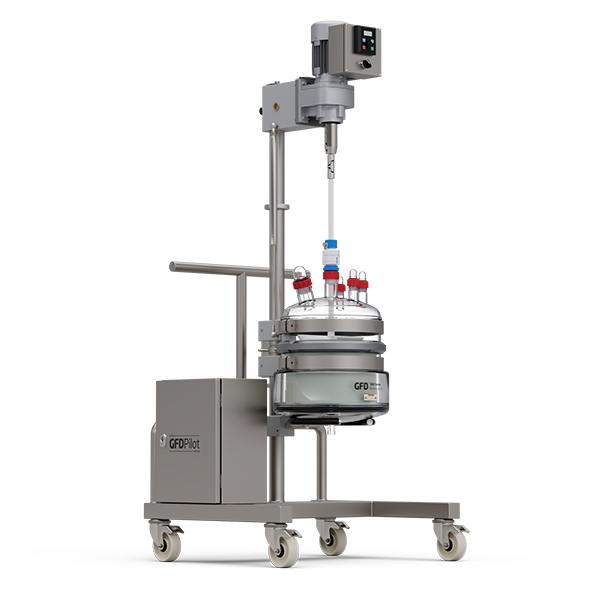
The GFD®Pilot Nutsche Filter Dryer from Powder Systems Limited is designed specifically to bridge laboratory crystallisation and commercial filtration specification. Operating at kilolab and pilot scale, it enables controlled filtration, cake washing, and vacuum drying within a single agitated vessel, forming a representative environment for process evaluation. The removable filtration basket accommodates interchangeable mesh pore configurations, allowing pore size to be adjusted systematically as particle size distribution, fines content, and cake structure evolve.
This capability supports resistance analysis, wash efficiency optimisation, and empirical surface area determination under defined pressure conditions. When equipped with interchangeable mesh pore plates, the GFD®Pilot functions not merely as a development unit, but as a practical scale-up verification platform that converts pilot-scale filtration behaviour into robust commercial design inputs. Speak with our specialists for more information about the GFD®Pilot.